Busan BGSS Eye Clinic · JCI-Accredited Ophthalmology Since 1997 · 7-Language Patient Care
JCI-Accredited · Since 1997
en-US

Presbyopia Correction · Needs Clinic Confirmation
Presbyopia Lens Implantation
Presbyopia lens implantation is an intraocular surgical procedure in which the eye's natural crystalline lens — is replaced with a precision-engineered multifocal artificial intraocular lens (IOL) that restores clear vision at near,
Schedule a ConsultationWhat Is Presbyopia Lens Implantation? Multifocal IOL Surgery for Age-Related Vision Loss in Busan

Presbyopia lens implantation is an intraocular surgical procedure in which the eye's natural crystalline lens — which loses its flexibility with age, causing the progressive near vision loss characteristic of presbyopia — is replaced with a precision-engineered multifocal artificial intraocular lens (IOL) that restores clear vision at near, intermediate, and far distances simultaneously. Unlike laser vision correction, which reshapes the cornea, presbyopia lens implantation works by modifying the refractive power of the crystalline lens itself — leaving the cornea entirely untouched.
This distinction makes presbyopia lens implantation at Busan BGSS Eye Clinic in Seomyeon, Busanjin-gu the appropriate option for a wide range of patients beyond those with straightforward age-related near vision loss: it is equally safe and effective for patients with a history of LASIK surgery, extreme high myopia, or thin corneas — conditions that may complicate or contraindicate corneal laser approaches to presbyopia management. The procedure simultaneously addresses the early cataract development that commonly accompanies presbyopia in the 40s–50s age group, making it a proactive intervention that manages both current visual discomfort and future lens-related disease risk.
At the Seomyeon, Busanjin-gu clinic, presbyopia lens implantation is supported by the BGSS network's data mining-based prediction model — built from 628,000+ clinical cases accumulated since 1997 — which continuously refines lens selection, power calculation, and surgical planning to deliver optimal outcomes for each patient's individual eye condition and lifestyle at the Busanjin-gu, Busan facility.
Who Needs Presbyopia Lens Implantation in Busan?
Presbyopia affects virtually everyone from their early 40s onwards as the crystalline lens progressively loses elasticity. Our team at Busan BGSS Eye Clinic in Seomyeon evaluates each patient's visual needs, ocular health, and daily lifestyle before recommending the most appropriate presbyopia correction pathway and IOL type.
Ideal candidates for presbyopia lens implantation at the Seomyeon, Busanjin-gu clinic include:
Adults in their 40s and 50s experiencing progressive difficulty with near vision — reading glasses, phone use, or close-up tasks requiring increasing effort at the Busanjin-gu, Busan facility
Those wanting simultaneous near, intermediate, and far vision correction without dependence on reading glasses or bifocals after surgery at the Seomyeon clinic
Patients with a history of LASIK or LASEK for whom corneal-based presbyopia correction is not advisable — lens implantation bypasses the cornea entirely
Those with extreme high myopia who are experiencing the combined burden of distance and near vision correction — multifocal IOL addresses both simultaneously at the Busan facility
Patients with thin corneas for whom laser presbyopia correction is contraindicated — the crystalline lens approach is cornea-independent
Those with early cataract development alongside presbyopia — lens implantation proactively addresses both conditions in a single procedure at the Seomyeon, Busanjin-gu clinic
Patients seeking a long-term vision solution rather than progressive reading glasses — multifocal IOL provides durable correction without the regression associated with laser approaches
International patients traveling to Busan in their 40s–50s seeking a comprehensive presbyopia correction program with multilingual support and ongoing age-related eye disease management
Our Team at Busan BGSS Eye Clinic, Seomyeon
Presbyopia lens implantation at Busan BGSS Eye Clinic is performed and managed by our team of five senior directors — M.D. Ph.D. ophthalmologists with 20 or more years of surgical experience — each holding concurrent academic appointments at major regional universities in Busan. Intraocular surgery is among the most technically demanding specialties in ophthalmology, requiring not only surgical precision but deep expertise in IOL selection, power calculation, and Asian ocular anatomy adaptation. Our team's lens implantation program draws on the BGSS network's 628,000+ accumulated clinical cases to match each patient's eye condition, lifestyle, and visual priorities to the most appropriate multifocal IOL from the full range of world-class lens options available at the Seomyeon, Busanjin-gu facility.
The multi-director team structure at the Busanjin-gu, Busan clinic is a specific advantage for presbyopia patients in their 40s–50s: age-related eye changes do not occur in isolation. Presbyopia accompanies early cataract risk, dry eye, glaucoma susceptibility, and retinal changes — conditions covered across our team's five directors, whose expertise spans cataract surgery, corneal disease, glaucoma, vitreoretinal surgery, and oculoplastics. Post-operative care at the Seomyeon clinic therefore includes access to the full multi-specialty team, not just the operating surgeon.
Presbyopia Lens Implantation Treatment Areas and Vision Improvements

Near Vision Restoration: The primary focus of presbyopia lens implantation at the Seomyeon, Busanjin-gu clinic is restoring comfortable near vision — reading, smartphone use, and close-up tasks — that progressive lens stiffening has compromised. Multifocal IOL technology distributes incoming light across multiple focal points within a single lens, allowing the eye to focus at near distances without reading glasses. Our team selects the IOL design best matched to each patient's near vision demands and lifestyle at the Busanjin-gu, Busan facility.
Intermediate and Far Distance Vision: Unlike reading glasses or monovision approaches, multifocal IOL surgery at the Seomyeon clinic restores functional vision across all three focal zones simultaneously — near, intermediate (computer screen distance), and far. This trifocal visual correction is particularly important for patients in their 40s–50s who are professionally or socially active and cannot accept gaps in any focal range. IOL selection at the Busan BGSS facility accounts for each patient's dominant focal distance needs and working environment.
Cataract and Age-Related Disease Prevention: By replacing the natural crystalline lens before significant cataract development occurs, presbyopia lens implantation at the Seomyeon, Busanjin-gu clinic proactively removes the anatomical substrate for future cataract formation. Our team's post-operative management program includes scheduled monitoring for cataract, glaucoma, dry eye, and retinal disease — conditions whose incidence increases in the same age group targeted by presbyopia correction at the Busan facility. Results vary by individual and no specific visual outcome is guaranteed.
Presbyopia Lens Implantation Procedure Steps and Recovery
Presbyopia lens implantation at Busan BGSS Eye Clinic in Seomyeon, Busanjin-gu is performed under topical and/or local anaesthetic with no general anaesthesia required:
Comprehensive Pre-Operative Assessment — Our team conducts detailed biometry, corneal topography, anterior chamber measurement, macular OCT, and lifestyle evaluation at the Seomyeon clinic. These data points — combined with the BGSS prediction model built from 628,000+ cases — determine IOL type, power, and surgical approach for each eye at the Busanjin-gu, Busan facility.
Personalized IOL Selection — From the full range of world-class multifocal IOLs available at the Seomyeon, Busanjin-gu clinic, our team recommends the specific lens design and power that best matches the patient's ocular anatomy, Asian eye dimensions, refractive history, and visual lifestyle priorities at the Busan facility.
Laser-Assisted Lens Surgery — Catalys and VICTUS femtosecond lasers are used for precision lens fragmentation and capsulotomy preparation at the Seomyeon clinic. ZEPTO precision capsulotomy technology enables complete, accurately sized capsule opening for optimal IOL centration and stability at the Busanjin-gu, Busan facility.
Lens Removal and IOL Implantation — The natural crystalline lens is removed using CENTURION or INFINITI ultrasound phacoemulsification under LUMERA 700 surgical microscopy at the Seomyeon, Busanjin-gu clinic. The multifocal IOL is then inserted and positioned precisely within the capsular bag. The entire procedure is performed through a small self-sealing incision requiring no sutures.
Immediate Post-Operative Assessment — Lens centration, IOL position, and intraocular pressure are reviewed before discharge. Prescribed anti-inflammatory and antibiotic drops and detailed aftercare instructions are provided by our team at the Busan BGSS facility.
Structured Long-Term Follow-Up Program — Our team at the Seomyeon, Busanjin-gu clinic operates a scheduled post-operative examination program covering IOL position, visual acuity, IOP, dry eye management, and age-related disease monitoring. Collaborative specialist care across cataract, glaucoma, retina, and dry eye clinics within the Busan BGSS team ensures comprehensive management of the full spectrum of age-related ocular changes.
Presbyopia Lens Implantation Results, Safety, and Longevity
Presbyopia lens implantation at Busan BGSS Eye Clinic is supported by the BGSS network's 628,000+ clinical cases and data mining-based outcome prediction model — one of the most extensive clinical databases for presbyopia and cataract surgery in Korea. The network's research and development in presbyopia correction began in 1997 and has produced continuously refined surgical protocols and IOL selection algorithms optimized for Asian ocular anatomy at the Seomyeon, Busanjin-gu clinic. Results vary by individual and no specific visual outcome is guaranteed.
The safety profile of presbyopia lens implantation at the Busanjin-gu, Busan clinic is reinforced by the five-platform advanced laser system — Catalys, VICTUS, CENTURION, INFINITI, and ZEPTO — operating within a sterile surgical suite with controlled temperature, humidity, and air sterilization. Potential side effects include temporary halos around lights, mild glare, and an adaptation period as the visual system adjusts to multifocal optics — generally resolving within weeks to months. Serious complications are uncommon and our team's pre-operative assessment and long-term monitoring program minimizes risk throughout the patient's care journey at the Seomyeon facility.
Multifocal IOL correction is durable and long-lasting. Once the natural crystalline lens is replaced, the artificial IOL does not change over time under normal conditions. Age-related changes in other ocular structures — retina, optic nerve, cornea — are monitored through the BGSS post-operative management program at the Busan clinic. Our team discusses realistic expectations for visual adaptation and long-term outcomes with every patient before surgery is planned.
Why Choose Busan BGSS Eye Clinic in Seomyeon for Presbyopia Lens Implantation?
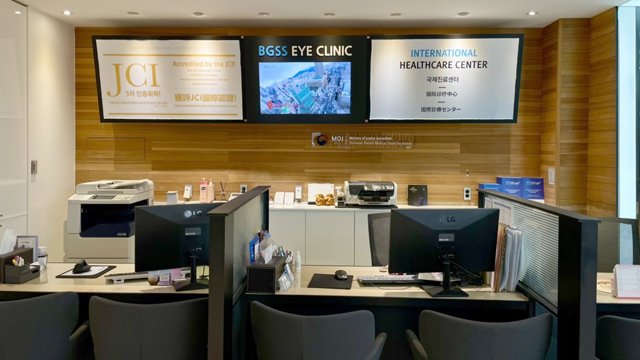
Busan BGSS Eye Clinic, located in Seomyeon, Busanjin-gu, Busan, began presbyopia correction research in 1997 — making it one of the longest-running presbyopia surgery programs in Korea — and has performed presbyopia and cataract lens surgery since 2000. The Seomyeon clinic's presbyopia program rests on four structural advantages unavailable at most single-specialty refractive clinics: a multi-director team covering every age-related ocular subspecialty; the full range of world-class multifocal IOLs selected to Asian ocular anatomy; a five-platform advanced surgical system; and a formal long-term post-operative management program for age-related eye disease. As the founding BGSS location since 1997 with 330,000+ vision correction surgeries, the Seomyeon clinic's credentials are clear:
First ophthalmology clinic in Korea to receive JCI accreditation — four cycles
Advanced Regenerative Medicine Institution (2026) and Asia-Pacific EVO ICL Training Center (2026)
628,000+ clinical cases with data mining-based IOL outcome prediction model
Five advanced laser platforms — Catalys, VICTUS, CENTURION, INFINITI, ZEPTO — in a sterile, temperature and humidity-controlled surgical center
Key Medical Tourism Cooperative Institution, City of Busan — multilingual support in Chinese, English, Japanese, Mongolian, Russian, Vietnamese, and Indonesian
Patient Experiences: Presbyopia Lens Implantation at Busan BGSS Eye Clinic, Seomyeon
Patient Vignette 1 — Presbyopia with Cataract Risk, Early 50s
A patient in their early 50s visiting Busan had been managing progressive near vision loss with reading glasses for several years and was also showing early lens opacity changes. Following comprehensive biometry and lifestyle assessment at the Seomyeon, Busanjin-gu clinic, our team recommended multifocal IOL implantation to address both presbyopia and early cataract risk simultaneously. Near, intermediate, and far vision all improved after surgery, and the patient reported reduced dependence on reading glasses within the first month at the Busan BGSS facility. Results vary; no outcome is guaranteed.
Patient Vignette 2 — Post-LASIK Presbyopia, Late 40s
A patient in their late 40s at the Busanjin-gu, Busan clinic had undergone LASIK years earlier and was experiencing progressive near vision difficulty. Corneal-based presbyopia correction was assessed as unsuitable given the previous ablation. Our team at the Seomyeon facility recommended presbyopia lens implantation as the cornea-independent alternative. Vision across all distances improved post-surgery, and the patient was enrolled in the BGSS long-term age-related disease monitoring program. Individual results vary and no specific outcome is guaranteed.
See Clearly at Every Distance — Book Your Presbyopia Consultation in Busan
If near vision loss, reading glasses dependence, or age-related visual decline is affecting your daily life, our team at Busan BGSS Eye Clinic in Seomyeon, Busanjin-gu is ready to evaluate whether presbyopia lens implantation is the right solution for your eyes. With presbyopia correction research since 1997, 628,000+ clinical cases, JCI accreditation, five advanced laser platforms, and a multi-director team covering every age-related ocular subspecialty, the Seomyeon clinic offers the IOL expertise and long-term management program that presbyopia patients in their 40s and 50s deserve. International patients are fully supported in Chinese, English, Japanese, Mongolian, Russian, Vietnamese, and Indonesian.
**[Book Your Free Presbyopia Lens Implantation Consultation at Busan BGSS Eye Clinic](/contact-us)
Other Services
Explore our comprehensive range of healthcare offerings tailored to your needs.
Dry Eye Diagnostic Testing
It is a spectrum of disorders with distinct underlying mechanisms — each requiring a different clinical response.
Learn More

Aqua IPL / Aqua Lifting
Dry eye syndrome is one of the most common and undertreated conditions in ophthalmology — affecting contact lens wearers, digital screen users, post-surgical patients, and adults over 40 with progressively declining tear film quality.
Learn More
Autologous Serum Eye Drops
Autologous serum eye drops are a specialized therapeutic preparation in which a patient's own blood is processed to extract the serum — which is then formulated as personalized eye drops.
Learn More